Compact trikes combine the stability of a tricycle with the manoeuvrability of smaller cargo bikes. This design is particularly suitable for companies that value easy loading and unloading without sacrificing agility in city traffic.
Compact trike

Stability and weight efficiency in a compact design
Technical equipment
Compact tricycles offer optimum stability when loading and unloading and when stopping at traffic lights (provided they do not have tilting technology) thanks to their three wheels. Despite their tricycle configuration, they remain compact in design and offer intuitive handling characteristics.
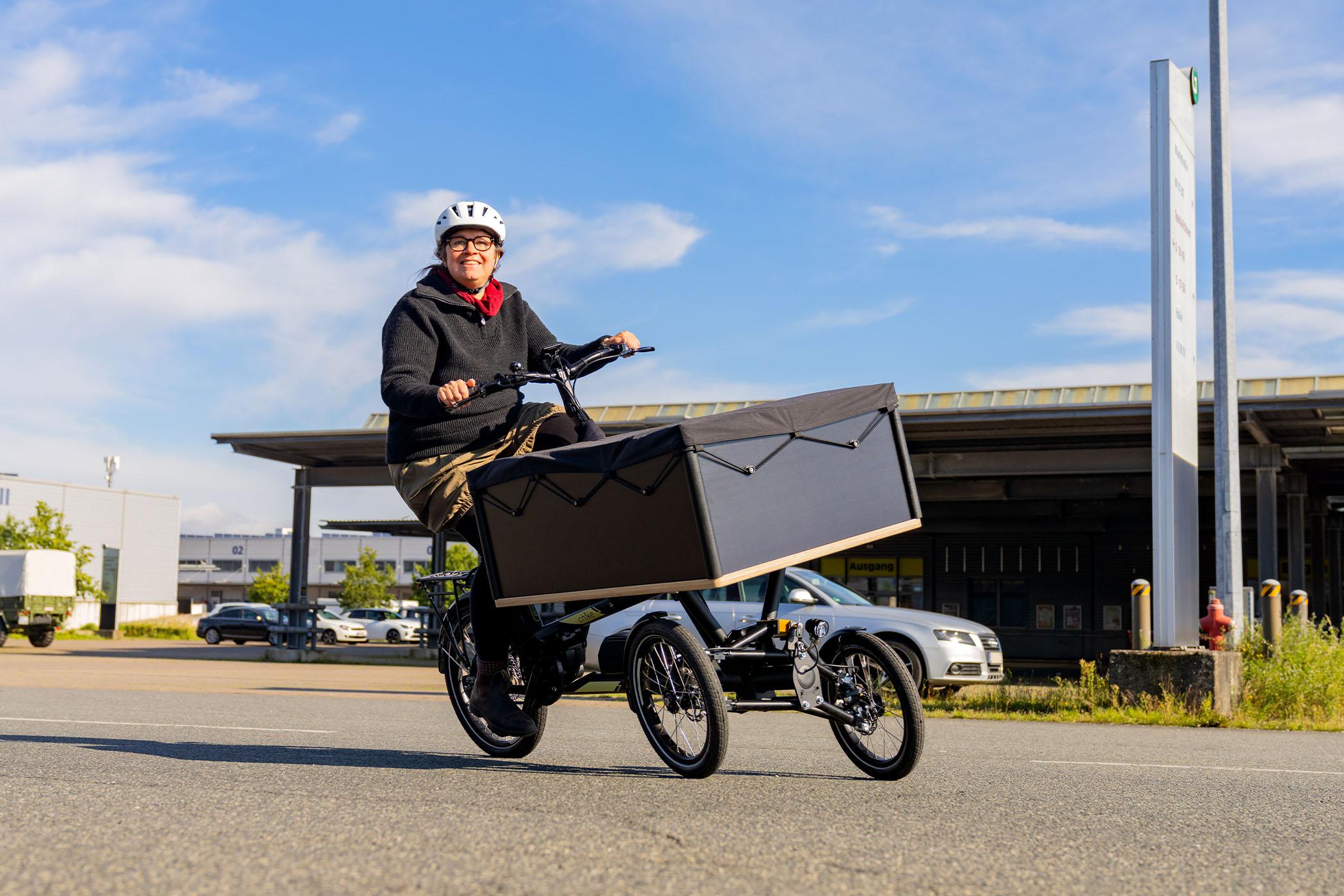
Features and benefits
Stability when loading: The third wheel ensures that the cargo bike remains stable even when stationary. This makes loading and unloading easier.
Compact dimensions: Despite having three wheels, these models are significantly more compact than larger trikes.
Intuitive handling: Even employees with no experience of cargo bikes quickly get to grips with the riding dynamics.
Different steering systems
Pivot-/swivel axle-steering
With pivot steering, the entire rigid front axle, including the box above it, pivots on a bogie. Road surface irregularities have a direct effect on the steering. When cornering, the wheels move closer to the centre axle, which increases the potential risk of tipping over in fast corners.
Kingpin-/ Ackermann-steering
With Ackermann steering, the front wheels are controlled indirectly via a steering trapezoid. Since the front wheels require a relatively large amount of space for the steering angle, there is less space for the transport box. The handling is pleasant – especially on models with additional tilt technology.
Rear-wheel-steering
With rear-wheel steering, the rear wheel is controlled via a steering linkage. The drive runs forward under the loading area. Since the rear and thus also the saddle move sideways when cornering, the driving experience feels unfamiliar at first. On the other hand, the wheels are very manoeuvrable – and rare!