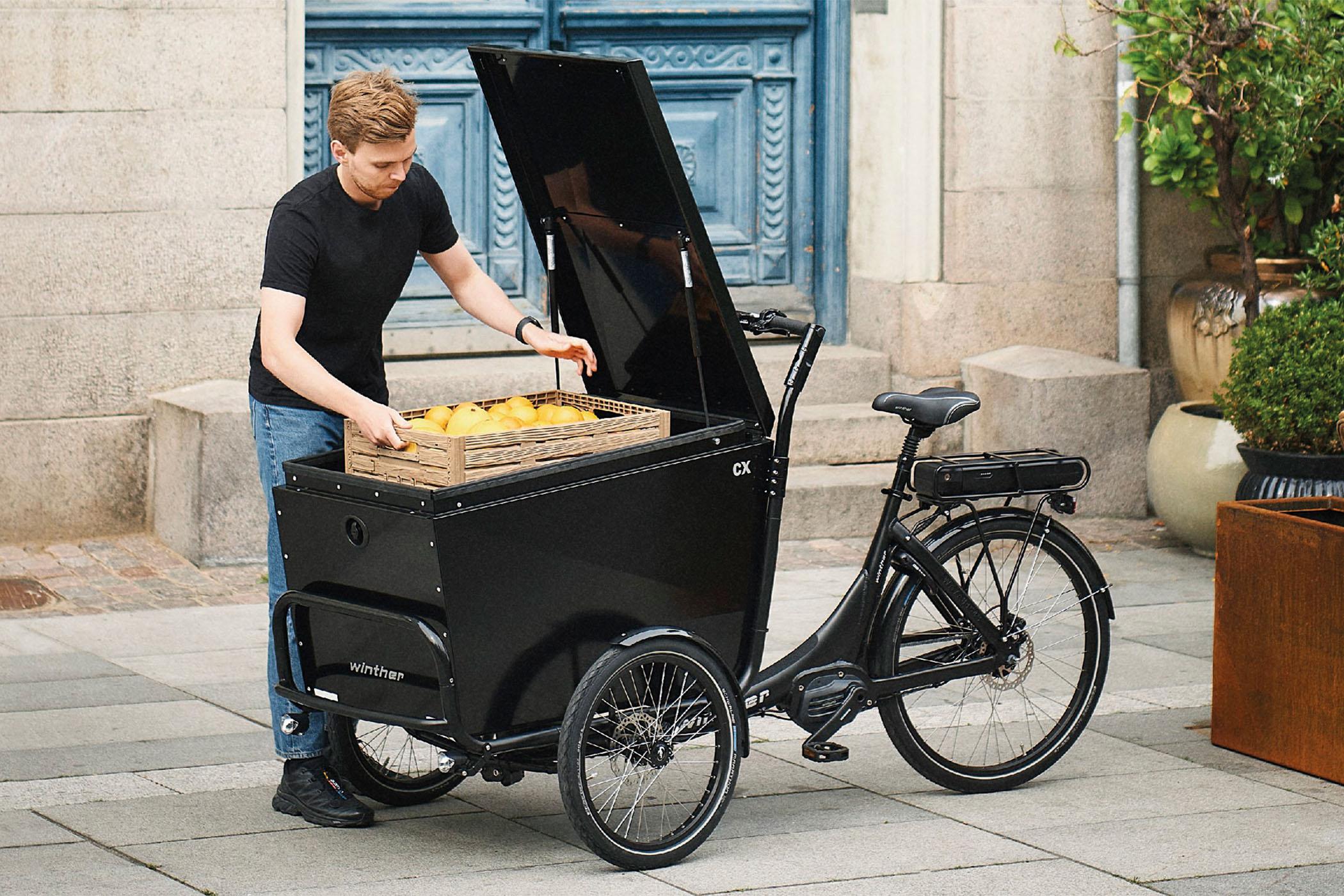
Tricycles with a loading area at the front usually have a rear section similar to that of a ‘normal’ bicycle, so no adjustments to the drive and chain are necessary (exception: bikes with rear-wheel steering). The cargo is visible and the cargo space between the front wheels is lowered as far as possible in the design. Compared to the Long John, tricycles are usually wider but shorter (many models are between 200 and 220 cm long). They also often offer more cargo capacity.
Trike

Stable transport solution with high load capacity
Dimensions and capacity
Compared to Long Johns, tricycles are generally wider but shorter – many models measure between 200 and 220 cm in length. This compact design makes them particularly suitable for city use, while often offering more load capacity than two-wheeled cargo bikes.
Stability as the main advantage
A major advantage of tricycles is their stability: they can be loaded and unloaded stably even when stationary, without having to repeatedly jack up the bike. This is particularly advantageous when making frequent stops and transporting heavy goods.
Please note
The greater width requires a little more attention when riding through narrow passages. In addition, the handling may take some getting used to at first, as classic trikes steer differently from conventional bicycles.
Different steering systems
Pivot- / swivel axle steering
With pivot steering, the entire rigid front axle, including the box above it, pivots on a bogie. Road surface irregularities have a direct effect on the steering. When cornering, the wheels move closer to the centre axle, which increases the potential risk of tipping over in fast corners.
Kingpin- / Ackermann steering
With Ackermann steering, the front wheels are controlled indirectly via a steering trapezoid. Since the front wheels require a relatively large amount of space for the steering angle, there is less space for the transport box. The handling is pleasant – especially on models with additional tilt technology.
Rear-wheel steering
With rear-wheel steering, the rear wheel is controlled via a steering linkage. The drive runs forward under the loading area. Since the rear and thus also the saddle move sideways when cornering, the driving experience feels unusual at first. However, the wheels are very manoeuvrable – and rare!